

Compounding: How Some People Become Unrecognizable
141: The 8th wonder of the world... And how to actually use it.

Compounding is magic. Look for it everywhere. - Sam Altman
The 8th wonder of the world… Compounding
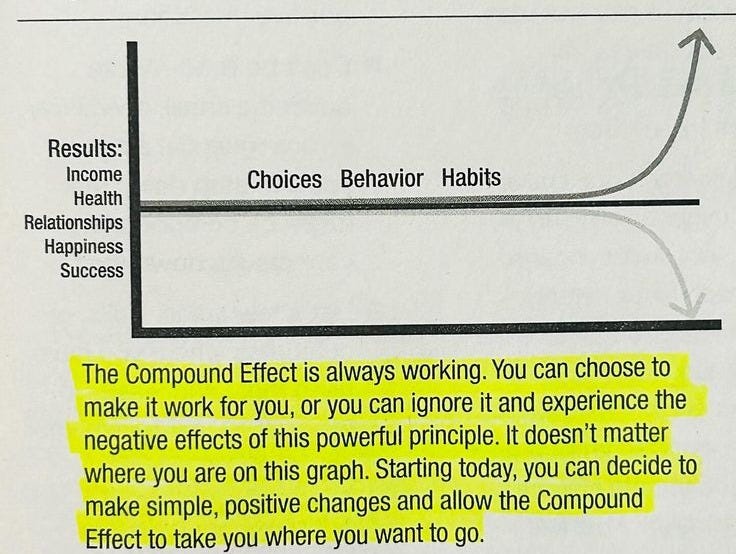
Most people understand compounding when it comes to money. Giving you the idea that the longer you invest, the faster things start working out in your favor. Results? More money in return. What those same people miss is that compounding works in every single area of life. Your skills. Your relationships. Your knowledge. Your health. Every single one of them either works in your favor or against you. Meaning? We underestimate the importance of everyday effort and the weight behind it… Ignoring the fact that progress in life does not work linearly.
1. Everything in life compounds
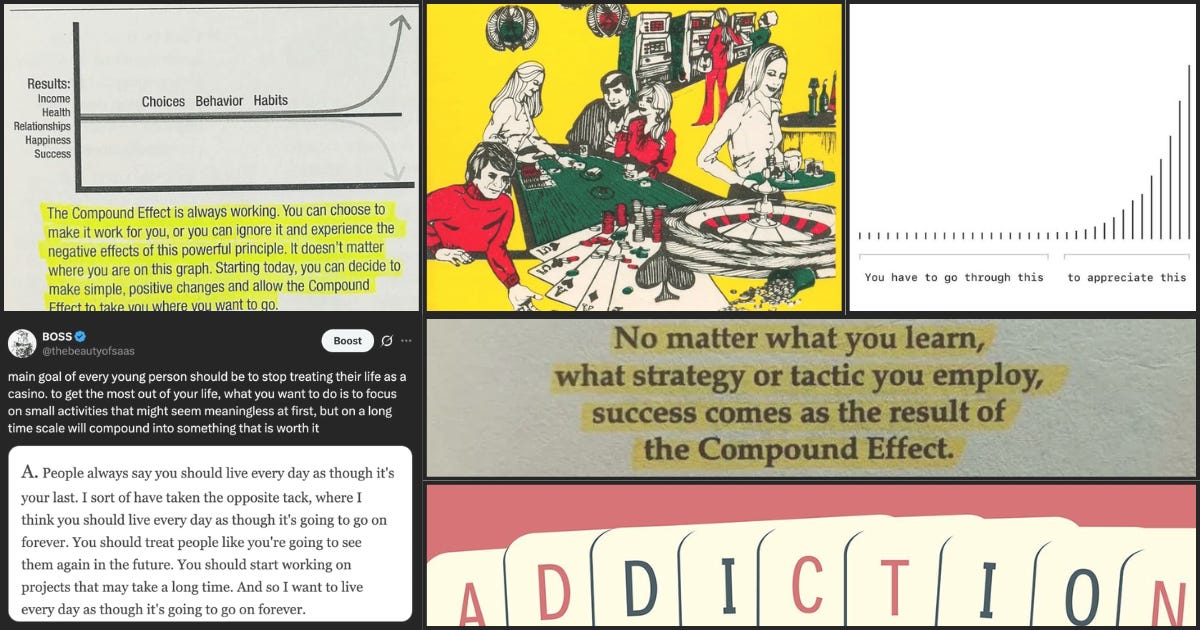
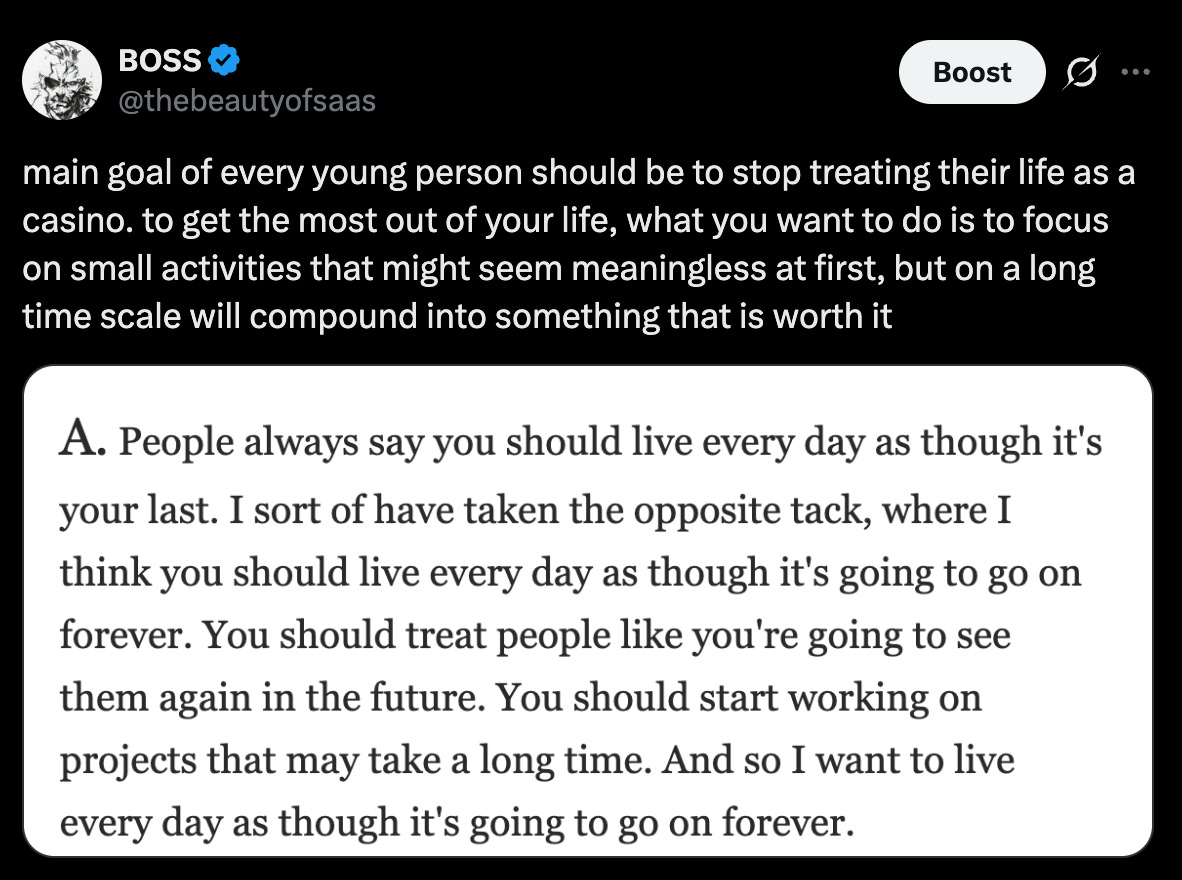
The most important thing you have to take out of this read? Everything in life compounds. Not just money. Also, your skills, health, relationships, and mindset. There is no neutral. The problem with casino culture and the attention economy we live in? Individual days do not seem to matter much. Everyone believes that results arrive fast and require minimal effort. Wrong. The way you want to start approaching things is from a decade perspective and considering how each action you take compounds.
Reading 15 minutes daily gets you to 10 books a year. Training 3 times per week gets you to around 130+ sessions in a year. Working on your side business for 1 hour per day gives you 365 hours for your business. The same framework applies to everything else. Run the numbers, and you will quickly realize how unrecognizable you will be from where you started with a year of focused work.
Run the numbers yourself. This is exactly why what you are doing daily matters (even with 50% effort) more than what you do occasionally. Everyone knows someone who goes 110%… Burns themselves out and never achieves anything because they completely miss out on compounding and its power. The game is not won by the one who works the hardest. It is won by whoever stays the longest.
2. Things get better over time
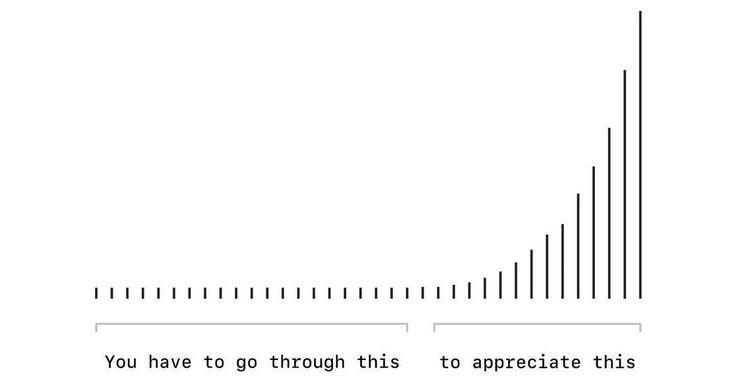
Compounding comes down to the process itself. You often find yourself feeling like nothing is working. The lucky ones are those who only feel that for short periods after wins. The unlucky ones feel it permanently, even when they are performing better than ever. This is what most get wrong. They have been convinced that all of your progress should look like quantum leaps, not taking into consideration that things are quite the opposite. Small. Meaningless. Useless. At first…
It is one of the reasons people quit or start to doubt themselves when they should not. Your effort and the experience that comes with whatever you are doing never goes to waste. The only requirement? Not to give up. Those who figure this out early in life have a massive advantage over those who do not. Positioning themselves in a scenario where their ability to pivot to something new and rely on prior knowledge and experience makes them immune to loss.
3. Casino culture and attention economy are the enemies of compounding (why people fail)

Casino culture: Get rich quick. Minimal effort. Treating everything as a jackpot. It is a drug that keeps ambitious people in a loop of chasing the wrong things, focusing on what will get them nowhere, and thinking they are always one action away from the big win. Consequences? You are conditioned to expect fast and visible results.
In a casino:
Outcomes are random - they have nothing to do with your skill
Rewards are immediately visible - you either win or you don’t
The feedback loop is measured in seconds
The next bet always feels like the real opportunity
Read what it takes to remove casino behavior from your life.
What is the total opposite of compounding? Everything else around you.
When everyone is treating their lives as one big casino. Hoping to hit it big with the least work and effort possible. That is when you start to remind yourself that you do not want to participate in that. Because everyone else around you has trained their brain to expect big and unpredictable results. Rejecting everything that requires work, or is slow and boring. Results?
You already know it.
They spent their whole lives stuck in the loop of nothingness, with nothing to show for it and nothing to be proud of. Compounding is the exact opposite. Making it completely irrelevant as a way of life for those who have fallen victim to the casino lifestyle. Never being able to get out of the game is designed to make them lose while making them feel like they are the ones who will get lucky and win.
4. Why most never understand (because it is not visible)
Wrong metrics: Revenue. Weight. Friendships. Followers. The reason they are bad indicators and wrong metrics is that they move slowly. Yet people track them daily, so they notice no change and quit.
Metrics worth following:
The hours of work you put in
Number of sessions completed
All the other ones that are fully in your control and move daily.
The reason compounding is such an abstract term is that it is by design invisible. None of us can actually measure how fast (or slow) we are progressing. All of us have different starting points, goals, and projects. So where do things get complicated? Humans are designed to trust what they can see. To feel like you are moving forward, your progress needs to be tangible. You have to see it in one way or another. Which is not something you will be able to do for most of the things you are going after or at least not in the early phases.
The common scenario:
You start your first online business and work on it day and night for three months. You have been running the social media around it. But it seems like nothing has been working out, and you have not made a single sale. After three months? You quit. What you didn't take into consideration was that your social media presence had grown 12x, and you were on to something. Getting more clicks and driving more traffic to your page. Yet your only focus was the checkout page and the money in the bank account. Being completely unaware of the fact that you were actively compounding. Better said… That you were progressing.
The same principles apply to everything else. It doesn't mean that things are not working out if you are not seeing rapid progress. It might just mean that you are following the wrong metrics. Things are more often than not invisible until they are not. And once they become visible, it all becomes apparent how you did it. This is also why most people never get there. The moment results stop being immediately visible, they get back in the casino. Hoping to hit the jackpot.
5. Time component and why it matters
Time is the multiplier that supports everything else in compounding. It is also the most underrated factor in progress. Underrated in the sense that most are focused on how much intensity they are putting out and what strategy they are using, while completely ignoring the fact that time matters more than both combined. There are no shortcuts around it. Shorter and more intense periods of focus never produce what an uninterrupted, consistent period does. Remember our previous point about 110% for two weeks?
This is also where it becomes clear that the best time to start was yesterday. No matter what you are trying to do and achieve. Give yourself more time and space to achieve the results you want.
The earlier you get into something → the more experience you accumulate → the more that experience accelerates everything else that is yet to come.
If you are still one of those who are not convinced… What you want to do is run the numbers.
Audit yourself:
How many hours am I spending on things I want to achieve?
What percentage goes to focused work - one that actually moves things forward?
What areas do I want to improve, but not utilize compounding (not participating in them).
These three answers will tell you a lot.
6. Your environment shapes what compounds
Compound interest is the eighth wonder of the world. He who understands it, earns it. He who doesn't? Pays it. - Unknown
The environment you are in is either working in your favor or against you. Often in a way that you will never notice until it is too late and you have to make drastic changes. The importance of the environment becomes clear the moment you realize that it determines what feels normal to you and what feels like too much. Setting you up with a baseline for everything else.
What creates your environment:
The people you spend your time with (family and friends)
The places you live, work, and spend your free time in
The content you consume and how it shapes the way you think (mental environment and how you perceive things)
The people component is, without a doubt, the most important. Since the early days of your life, the influence from teachers becomes apparent all the way until you manage to get rid of their programming. Add your parents and friends, and it all becomes crystal clear. Parents who spend all their free time watching TV without ever trying to improve anything make that a normal part of their reality. Imagine the opposite. Now imagine a scenario where your parents have been putting in ridiculous effort to improve their lives (and yours). It might make sense why you want to do the same for yourself and your family. It becomes your baseline because they made it normal.
When everyone around you treats mediocrity as normal, it becomes normal. When everyone around you treats hard work as something to strive for… That becomes normal. Your environment sets the baseline for everything. The same applies to friends, colleagues, or anyone else you spend your time with. Add the environment you live in, the places you spend your time in, and their effects.
The content you consume? Works in the same way. Every input you allow to enter your life shapes how you think, what you expect, and what you believe is possible. This is where being anti-algorithm and protecting your mental health comes into play. What happens when you combine all those environments? They compound. Working for you or against…
7. Discipline is the engine
To make compounding sustainable over the long term, it all comes down to discipline. Everyone who has been reading our blog for some time knows our opinion on motivation. It matters. It matters when you are starting something out and need that initial boost. After two weeks have passed… You realize that to pull something through, it will all come down to discipline. What about compounding? It requires consistency. Consistency requires showing up day in and day out. This means that no matter how you feel or what mood you are in, you have to do the work.
Building a discipline system:
Active effort required to push yourself towards work (initial phase driven by motivation)
The system is semi-working. But you are noticing the resistance on the days when you are at 50% of your maximum (the phase where most give up and never build their discipline)
No resistance. The system works without you ever thinking about it (the phase you want to operate from)
This is where things go wrong most. Discipline is not about punishing yourself or going through endless hours of pain. In the initial phase, discomfort is expected and should be embraced. That discomfort should be gone within 3 months. Putting yourself in a position where no matter what happens throughout your day, how hard your day is, or what kind of mood you are in. You have a system that works in your favor. Once you build that system and survive the initial phases (which are the hardest), you will find yourself executing every day without negotiation.
8. Your goal? Not to interrupt the compound
The reason this is the scenario you do not want to participate in is that every single interruption costs you. Losing the compounding and momentum those days would have generated, making it harder to start the next day. Another benefit of momentum-driven work is that each day becomes easier, reducing resistance throughout the discipline system you are trying to build. Everyone reading this can relate to something they have been doing for months, only to skip it one day or go on a trip and never return to that same activity. This is also where casino culture becomes even more dangerous when you put it in context. It does not just distract you. It gives you a reason to interrupt yourself because you are out there chasing something "better". Every time you go on a side quest, you fall victim to hitting the jackpot. You are not just losing your time. You are also losing the things you have managed to build into your system.
It would be impossible to expect to operate at 100% all the time. It is also normal to take the day off. Yet it is important to realize that each of those choices directly influences the resistance you are building and directly interrupts the power of compounding. The wrong way to look at it is to ask yourself whether you are performing at your best. The right way to look at it is to ask yourself whether you are still performing. Because if you do… There is nothing out there that will manage to win you over. Time is working in your favor. Experience is working in your favor. Compounding is working in your favor.
9. Negative compounding and its effect
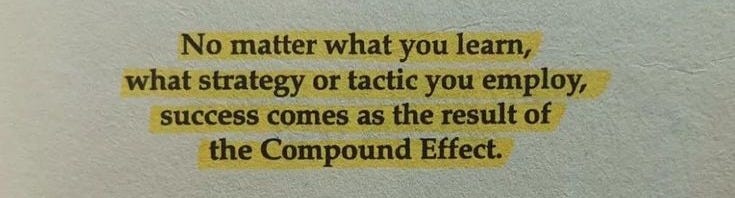
Now that the positive parts of compounding are covered. What about the negative ones? The same mechanisms work against you. Take, for example, someone who consistently skips the gym. Not only do they get out of shape… They also decline. Each week of not going makes the comeback harder, ultimately leading to skipping things altogether and resulting in further decline. None of this seems dramatic or visible while it is happening. When it comes to negative compounds, they are always different from the positive ones. Because it only becomes apparent once the gap between where you are now and where you should be… Becomes huge.
Why does this part deserve attention? Because when compounding works against you, it often moves faster than the positive one. Take that fitness example. The reality is that if you have built solid fitness and have not hit the gym for 2 months, you will end up looking (and performing) drastically below your baseline standard. The same way that reading books for 3 weeks won't replace years of algo abuse.
Every area of your life that you are not actively working on by default falls under negative compounding. And if you are still not convinced... Think about it. Not hitting the gym and not eating healthy? Body and health deteriorating. Being antisocial and spending most of your time at home? Losing relationships. You get the point. Compounding never stops. The only question is in which direction.
10. 90-day direction check - patience or dumbness?
When it comes to patience, compounding, and how to approach it, you have to be careful. Compounding doesn’t care which direction it works in. Remember? If you are focusing on the wrong stuff… You will be compounding in the wrong way. So far, the post has told you not to quit, which is the right way to approach this. But this framework will tell you when quitting and focusing on something else is the right move.
The trap is to convince yourself that you are being patient when you are actually wasting time on the wrong things. Every 90 days you want to ask yourself:
Am I getting better at the thing? Your focus here should be on your skill set. If you cannot point to one specific thing you can do now that you could not do 90 days ago... That is a massive red flag.
What are my leading indicators? Are they moving? The effort you are putting into it. Sessions and the number of activities completed.
Has there been a big change in the environment that changes the efficiency of the original concept? There is a good chance that what you are working on now won’t be relevant in 3 years. This is a sanity check you need to do often.
If 2/3 are negative and you do not have an answer to support what you are doing, then this means you are not being patient but quite the opposite. You are wasting your time. Instead, you should pivot to a path where your accumulated experience applies.
11. Patient one always wins
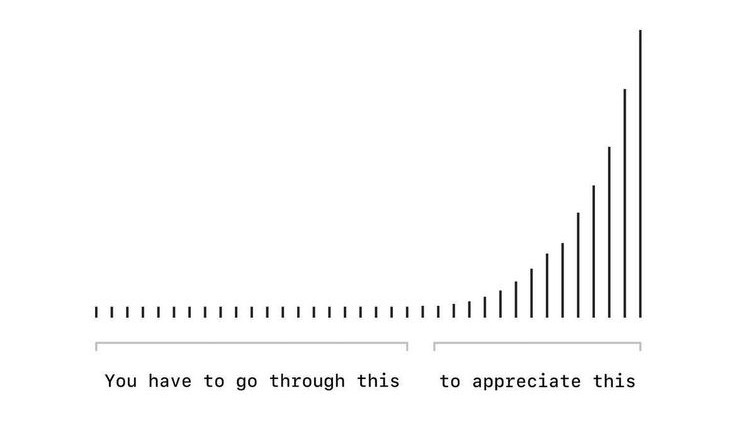
Before you misinterpret this… The passive ones DO NOT win. The patient ones do. There is a big difference between the two. Passive ones are wasting their time waiting for a miracle. Patient ones are putting in the work every single day without needing instant feedback. The reason this matters is that it is so rare that anyone who masters it has no competition in the long term. Most people fall into the category of pushing hard but quitting after less than a month without achieving the desired results. Take a two-week break. Back on track again. Repeating the cycle indefinitely. Completely missing out on the opportunity to compound and build something they could be proud of.
This is where the patient ones win the game. Ensuring they never got in the loop in the first place. When you are not competing with people who chase quick results and you know you will not quit... The results might not show immediately. But if you are doing what you should be doing and following the proven framework, there is nothing to worry about. The trick is pulling off the first 3-6 months, during which your internal belief system gets challenged. Mostly relying on the visible metrics while ignoring the smaller signals that play a crucial role in the whole approach.
The best part about trusting the process?
Once you have beaten self-doubt and pushed through the initial period, trusting the process becomes automatic. Experience + compounding now do the work for you, forming a new baseline that makes things easier because you have done it before.
12. Life worth living is all about compounding
None of this is complicated. That is the whole point of this post, and at the same time, the biggest problem. To get the most out of compounding, you do not have to be a genius. Neither does it require talent. It requires you to trust the process, work hard, and be patient. The only requirement is that you do not lose yourself to casino culture and abandon the process. The REAL results you are after are not built in the moment that looks impressive from the outside. It is all built on unsexy approaches and ordinary days.
Examples of positive compounding
These are realistic trajectories. Not guarantees.
Health
Daily activity: 10k steps a day. No junk food. 7+ hours of sleep on a consistent schedule.
30 days: Energy is more stable throughout the day. Sleep feels better, and you are waking up full of energy.
1 year: You look different in physical appearance, and the improvements are becoming more obvious. Perfect bloodwork results. More energy and drive to work.
5 years: Aging affects you less than people the same age who are doing nothing. Most days, you are full of energy and ready to take on new challenges.
Business
Daily: One hour of 100% focused work on just one idea, problem, or project.
30 days: Noticeable difference in your skill level. You can clearly see the improvement when you compare it with what you produced on day one.
1 year: What looked like no progress now makes complete sense. Output became even better. You found a small audience for your service. A new income stream started to come in.
5 years: This is now your primary income. You have access to people and opportunities that would not exist without the past five years of work. The compounding effect is becoming more obvious across your skills, network, and reputation.
Relationships (Romantic, business, friendships…)
Daily: Your goal is to have just one real conversation. No small talk.
30 days: You start noticing which people make conversation feel like work and which ones make it easy. As a result, you start spending more time with the easy group.
1 year: A few relationships have deepened and are past a surface level.
5 years: A handful of important relationships that have a massive impact on the quality of your life. A less wide social circle, but a more real one.
Mindset
Daily: Focusing on the long game and ignoring the casino thinking.
30 days: The internal self-belief system is noticeably getting better. Trusting in yourself finally makes sense. But you are still being pulled towards casino thinking.
1 year: The idea of hitting it big by getting lucky is becoming less attractive - the pattern others are operating based on is becoming more obvious. Internal belief system upgraded.
5 years: You operate differently from most people around you. Most people will not understand what you are doing or why.
No idea where to start?

Week 1: Pick ONLY ONE area (health, business, mindset, relationships) you want to get better at. Audit how many hours per week you are currently spending on it. Write that number down.
Week 2: Add 30 - 60 minutes of focused work per day based on your area of choice. Track it and do not switch between the areas. You only want to focus on one thing.
Week 3: Identify and remove any casino-like thinking (fast results, fast feedback loop…) from your daily routine.
Week 4: Count how many hours you have put into your chosen area. Then ask yourself, has any of this had a positive impact on your current situation?
Let the compounding work out in your favor.
Disclaimer: None of this is to be legal or financial advice of any kind.